AI in the BPO Industry: Transforming Outsourcing for 2025 and Beyond
1. TL;DR
Artificial intelligence is no longer the future—it’s the present driving innovation in Business Process Outsourcing (BPO). By 2025, over half of BPO providers will be leveraging AI-powered tools like chatbots and virtual assistants to manage up to 80% of routine customer interactions. This shift delivers faster responses, cuts costs, and allows human agents to focus on complex challenges. Beyond customer service, AI enhances risk management, compliance monitoring, and delivers predictive insights. While integration and data privacy challenges persist, businesses aiming for agility and a competitive edge must understand how AI is revolutionizing BPO.
Takeaway: AI transforms traditional outsourcing into a strategic partnership—smarter, quicker, and focused on meaningful results.
2. Editorial
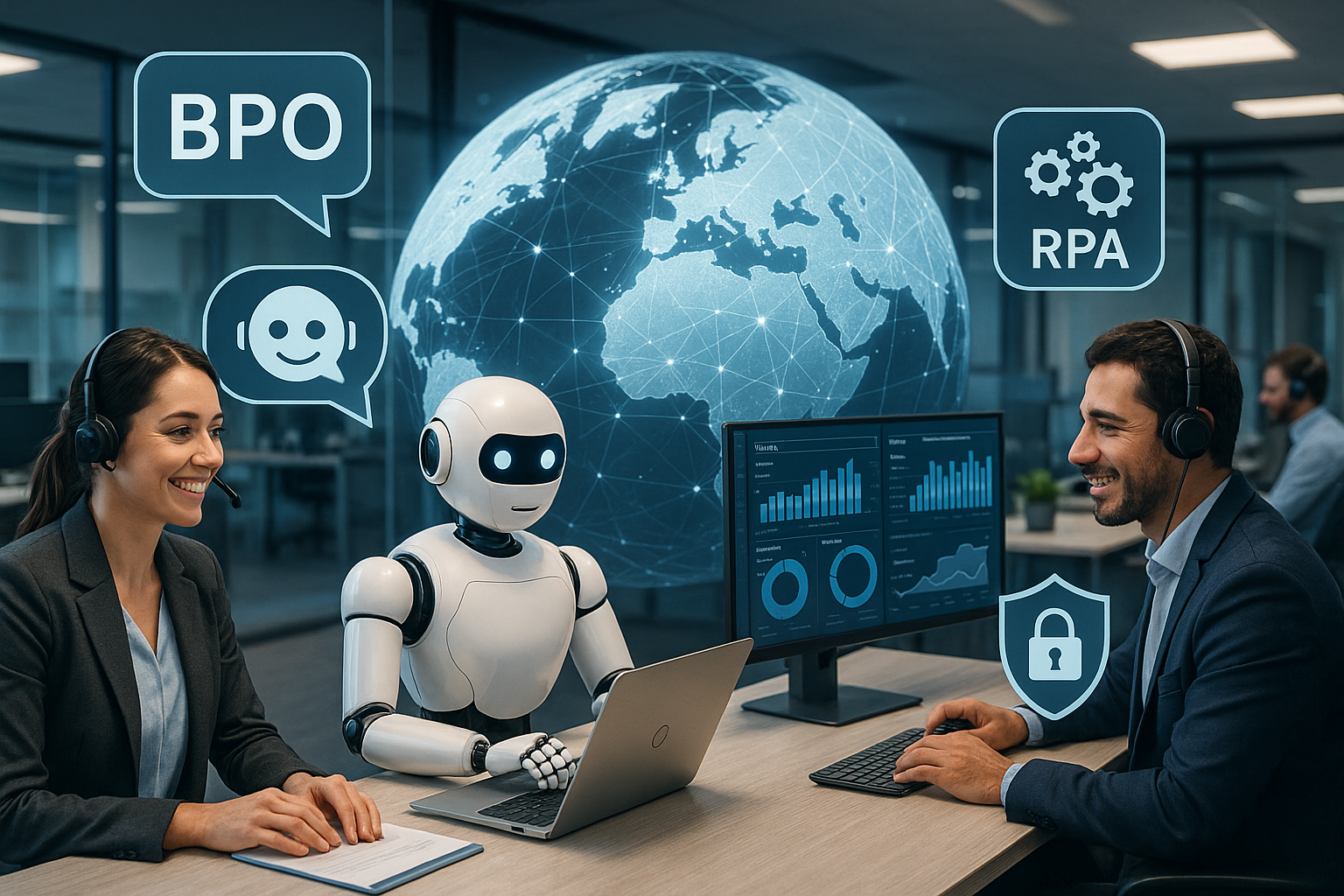
If you believe BPO is merely about low-cost offshore labor, it’s time for a new perspective. In 2025, AI is rewriting the BPO playbook—not by replacing humans, but by supercharging workflows. The emergence of large language models (LLMs), machine learning, and robotic process automation (RPA) enables providers to automate repetitive tasks while humans handle what machines cannot: empathy, judgment, and creativity.
Changing the BPO Game
Recall the days of endless phone menus and waiting to reach customer support? Today, AI chatbots manage up to 80% of routine inquiries instantly, 24/7. So your website isn’t broken—it’s answering efficiently with AI. This automation frees human agents to address sensitive or nuanced issues, elevating customer service from a chore to an advantage. But AI’s impact goes further. These bots don’t merely converse—they analyze, listen, and predict. They identify compliance risks, forecast customer demand, and detect fraud early. Particularly in high-stakes sectors like healthcare and finance, such AI-driven capabilities are transformative.
Why Businesses Should Care
Faster delivery, fewer mistakes, and significant cost savings are clear perks. But don’t worry about AI replacing jobs outright. Instead, the workforce is evolving. Skilled professionals now manage AI systems, interpret complex analytics, and intervene in exceptional cases. Moreover, AI enables outsourcing providers to shift focus from quantity metrics—like call volumes—to outcomes like customer satisfaction. Outcome-based contracts powered by AI analytics are becoming the industry standard, enhancing accountability.
The Bumps on the Road
The journey isn’t without challenges. Legacy IT systems can hinder seamless AI integration, and navigating varying international data privacy laws requires careful governance. Maintaining the delicate balance between automation and the essential human touch, especially where empathy is crucial, demands nuanced management. Ethical AI deployment and sustainability considerations are equally important. Leading BPO firms today integrate AI in ways that minimize waste, ensure fairness, and support ESG commitments. Because successful business transcends just profits.
Looking Ahead
Expect AI to delve deeper into outsourcing, creating smarter, faster, highly customized solutions. With AI-enabled BPO services growing at over 25% CAGR, the frontrunners will be those blending advanced AI technologies with insightful human expertise.
Takeaway: AI elevates BPO from a cost center to a strategic asset. Companies embracing this shift will enjoy resilience, delighted customers, and sustained growth beyond the ordinary.
3. Key Trends and Best Practices for AI in BPO
- AI-Powered Customer Support is Here to Stay Chatbots and virtual assistants manage the majority of customer inquiries around the clock.
- Automation Optimizes Back-Office Tasks Functions such as payroll, billing, and compliance processing run more smoothly thanks to RPA and AI.
- Outcome-Based Contracts Replace Task Counting Contracts now emphasize real-time results like customer happiness, monitored via AI dashboards.
- Combine Human Expertise with AI Strengths Upskill employees to collaborate with AI, managing exceptions and applying emotional intelligence.
- Prioritize Data Privacy and Governance Implement robust policies to navigate complex international data laws effectively.
- Leverage AI for Proactive Risk Management Use AI to predict demand spikes, detect fraud, and optimize resource allocation.
- Modernize IT Infrastructure for AI Compatibility Upgrade legacy systems to ensure quality data and smooth AI integration.
- Utilize AI to Enhance Sustainability Reduce paper workflows and energy consumption while meeting environmental, social, and governance (ESG) goals.
- Tailor AI Solutions by Industry Customize AI applications for sectors like healthcare and finance that require precision and strict compliance.
- Embrace Early AI Adoption and Innovation Pilot new tools promptly and collaborate with AI pioneers to maintain a competitive BPO edge.
4. FAQ
Q1: How is AI transforming BPO? By automating routine tasks, improving accuracy, and delivering actionable insights that enable smarter operations.
Q2: Which AI technologies lead in BPO? Chatbots, virtual assistants, robotic process automation (RPA), natural language processing (NLP), and predictive analytics.
Q3: Will AI replace BPO workers? No, AI manages repetitive tasks, while humans handle complex, emotional, and judgment-driven responsibilities.
Q4: How does AI enhance customer experience? It provides instant, 24/7 responses for common issues and equips agents with real-time insights for faster resolution.
Q5: What challenges does AI adoption in BPO face? Integration with legacy systems, data privacy compliance, regulatory adherence, and balancing automation with human expertise.
Q6: How does AI support compliance? By monitoring transactions continuously, identifying risks early, and flagging issues before escalation.
Q7: What is outcome-based outsourcing? Contracts that reward vendors based on performance metrics like customer satisfaction, tracked seamlessly by AI.
Q8: Why is workforce upskilling vital? Because humans remain essential for managing AI, interpreting results, and delivering empathy.
Q9: Which industries benefit most from AI-powered BPO? Healthcare, finance, telecommunications, logistics, and retail—fields with complex demands and regulatory requirements.
Q10: How does AI promote sustainability in BPO? By optimizing resource use, minimizing waste, and supporting ESG initiatives. Understanding AI’s integral role in today’s BPO landscape positions your business to thrive in an automated, data-driven future. If your BPO provider isn’t AI-savvy, it’s time to start asking some important questions.
Final thought: AI in BPO is no longer a luxury for the future—it’s an essential force reshaping how savvy companies achieve results. Are you ready to join the transformation?
