
The Content Orchestration System: From AI Intelligence to Revenue
Trinzik’s Content Orchestration System (COS) connects AI visibility intelligence, content generation, agentic domain infrastructure, and transaction orchestration into a single closed-loop pipeline.
Research → Create → Discover → Transact → (loop back to Research)
Of 43+ competitors mapped, zero span this full loop. Profound stops at analytics. Jasper generates without intelligence. Surfer bolts AI tracking onto search-era tools. Trinzik COS closes it.
Layer 1 GEO Intelligence
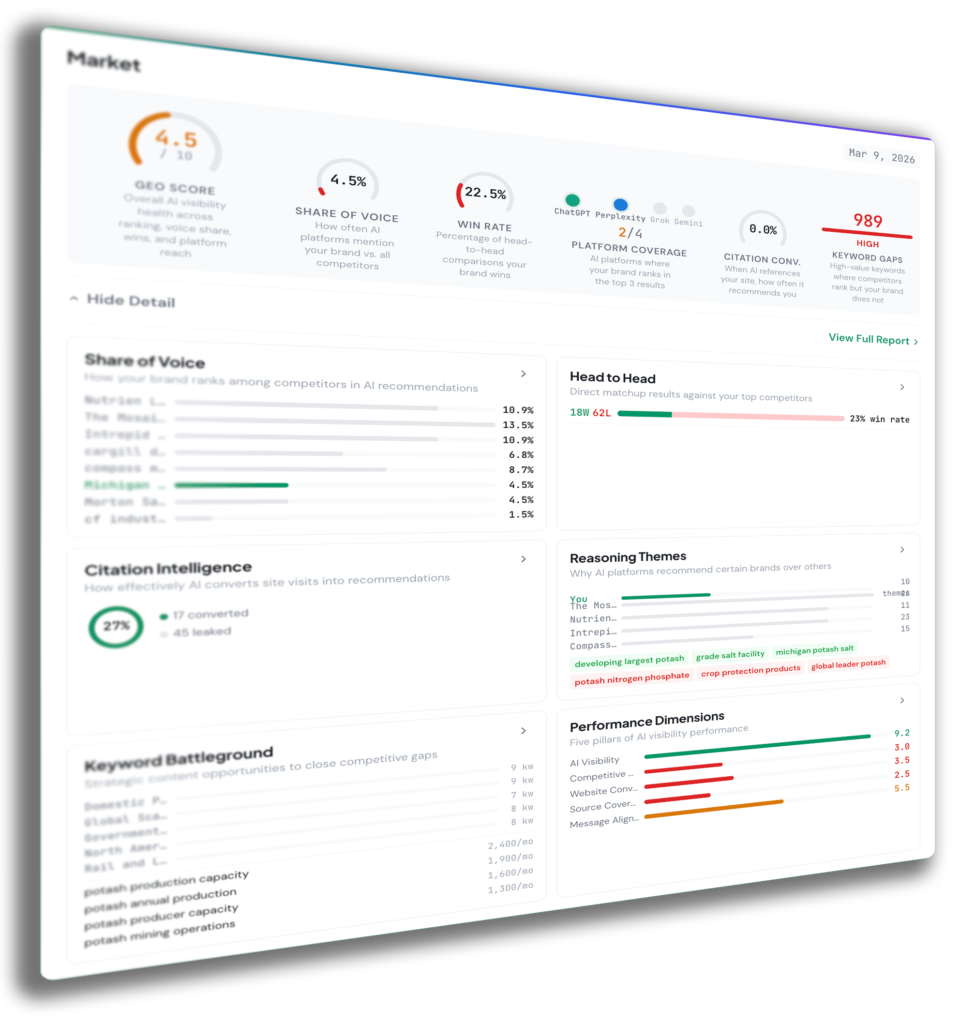
GEO Intelligence extracts forced reasoning from ChatGPT, Perplexity, Gemini, and Grok — the language patterns explaining why AI recommends one business over another. Market-synthesized perceptions, not brand marketing copy.
Campaigns: 30-100 discovery prompts with two human approval pauses before multi-vendor querying. Results populate 9 report screens covering SOV rankings, citation defensibility, keyword ownership, and competitive gaps. Automated monthly re-runs with locked prompts.
Correlation Engine: 10 axes mapping prompt types to themes, SOV, citation density, co-occurrence networks, temporal drift, and winner patterns.
Bridge Themes: Scored optimization vectors connecting search intent to recommendation language. Per-brand scoped, auto-injected into all three studios, re-generated after each campaign.
Layer 2 Content Lab
Three studios convert GEO findings into publication-ready content, backed by 6 vector knowledge tables and brand-customizable prompt templates.
- Blog Studio — 9-stage automated pipeline: web research, knowledge retrieval (6 pgvector tables, thresholds 0.30-0.60), draft generation with bridge themes, voice refinement, SEO optimization, image generation, HTML conversion, and storage. Publishing: draft, publish, schedule (60-second cron), or curate-only.
- Webpage Studio — WordPress inventory sync, SEO plugin detection, LLM-based AI citability audit, bridge-theme-optimized rewrites, before/after comparison, and publish back. Bulk audit and rewrite as background jobs.
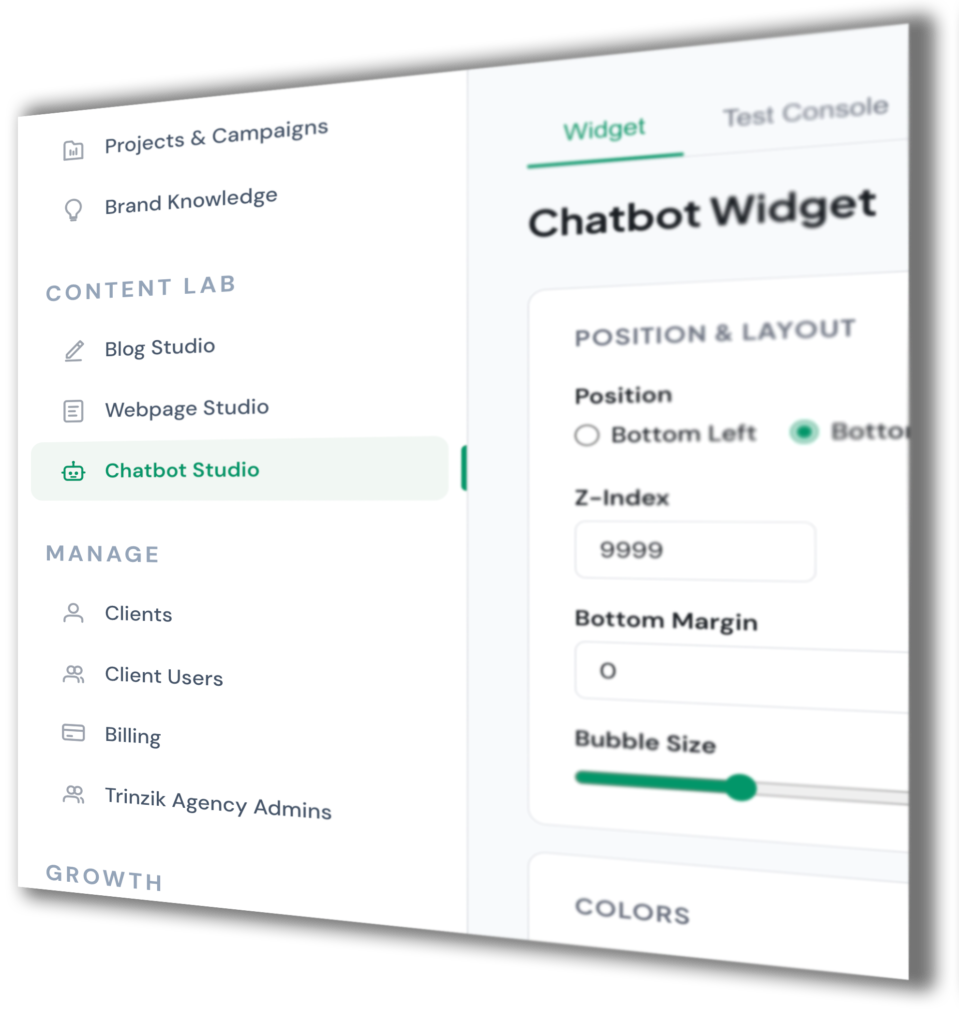
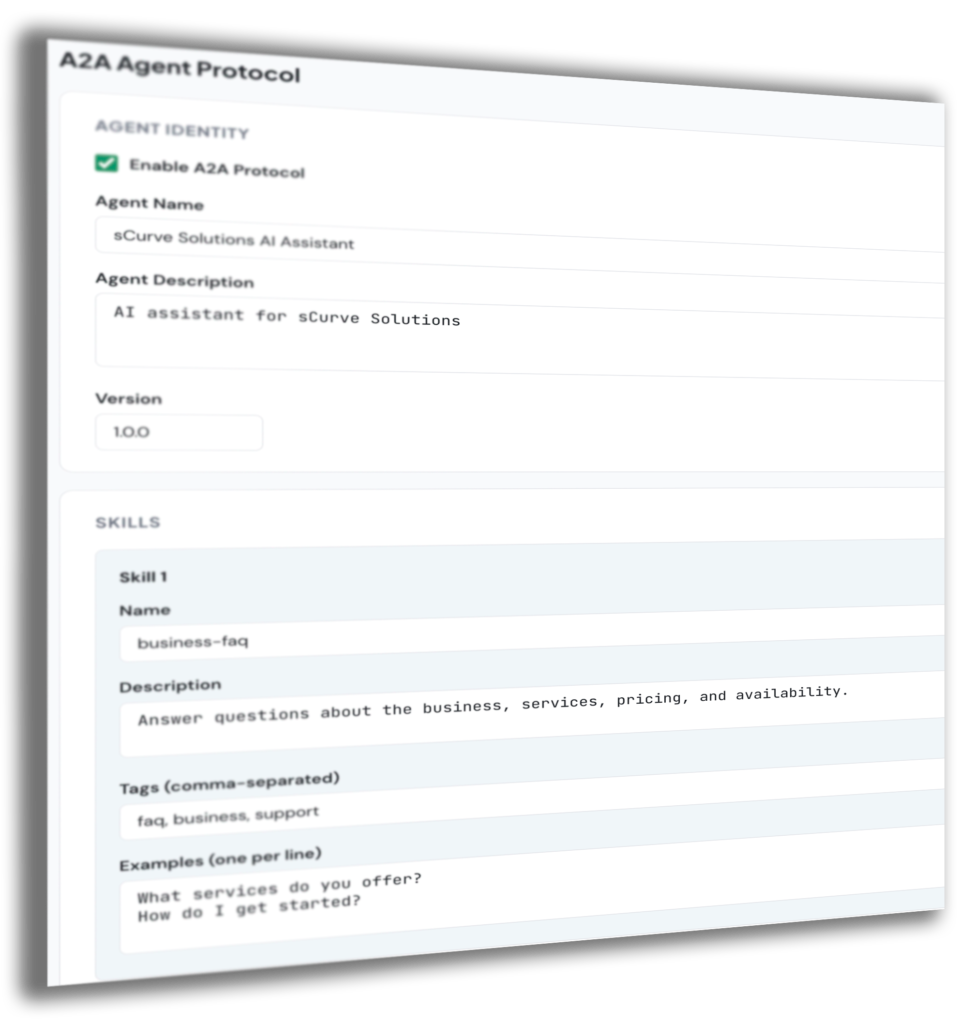
- Chatbot Studio — Claude Sonnet 4 semantic chunking, text-embedding-3-large vectors, multi-source retrieval with Cohere rerank-v4.0-pro, session memory, intent routing, escalation, embeddable widget (Shadow DOM, SSE), WordPress plugin. Google A2A v1.0 with 36-test conformance.
- Knowledge Management — 6 pgvector tables (text-embedding-3-small, 1536 dimensions) with per-table thresholds. Prompt Templates — stage-specific with brand overrides and variable injection.
Layer 3 Agentic Domain Infrastructure
Progressive domain capture with machine-readable endpoints for AI agent discovery and interaction.
- Agent Card at
/.well-known/agent-card.jsonfor AI agent discovery - WordPress Publishing directly to customer domain via REST API
- A2A Protocol Endpoints — JSON-RPC 2.0, Google A2A v1.0, 36-test conformance
- Domain-Level Vector Store — persistent, queryable brand knowledge for external agents
Of 43+ competitors, zero deploy agentic infrastructure on customer domains.
Layer 4 — Transaction Orchestration
Lead Intelligence extracts companies from GEO campaigns, scores on 6 dimensions, classifies into 4 tiers (ICP/Hot/Warm/Cold), and routes through a 5-stage Outreach Pipeline: Staging → Contact Discovery (Hunter.io + Perplexity) → Validation → Enrichment (DataForSEO + LLM company brief) → CRM Handoff (Twenty.com).
Of 43+ competitors, zero generate sales pipeline from their product’s output.
The Closed Loop Explained
- Cycle 1: GEO maps recommendations → Bridge Themes generate → Studios produce content → Content publishes to domain.
- Cycle 2: Re-run measures impact. New gaps surface. New bridge themes generate. Lead Intelligence scores 5-15 new prospects per campaign and routes to CRM.
- Cycle 3+: Each cycle accumulates optimization learning. Knowledge base grows. Domain infrastructure deepens. Pipeline compounds. The system measures the impact of its own recommendations.
The 4-Layer Test
| Company | GEO Intel | Content Engine | Agentic Infra | Transaction Orch. | Score |
|---|---|---|---|---|---|
| Trinzik COS | Full (4 vendors) | Full (3 studios) | Full (A2A) | Full (leads + CRM) | 4/4 |
| Profound | Full (10+) | None | None | None | 1/4 |
| Peec AI | Full (4) | None | None | None | 1/4 |
| Surfer SEO | Partial | Full (editor) | None | None | 1.5/4 |
| Jasper | None | Full | None | None | 1/4 |
| Semrush | Partial | Partial | None | None | 1/4 |
Of 43+ competitors, zero score above 2/4. Layers 3 and 4 remain uncontested.
Multi-Tenant Architecture
Agency → Brand → User hierarchy with Supabase RLS at the database level. Per-brand WordPress credentials, knowledge bases, voice profiles, chatbot configs, and CRM settings.
| Role | Scope | Capabilities |
|---|---|---|
| Super Admin | Platform-wide | All agencies, brands, users, billing |
| Admin | Agency-scoped | All studios, campaigns, leads, knowledge, templates |
| Client | Brand-locked | GEO reports (read-only), chatbot analytics, Blog Studio (if can_generate enabled) |
Feature flags and sidebar brand selector for single-session multi-brand management.
Platform Navigation
| Layer | Capability | Link |
|---|---|---|
| 1 — GEO Intelligence | 4-vendor querying, 9 reports, 10-axis Correlation Engine, Bridge Themes | [→ /platform/geo-intelligence/] |
| 2 — Content Engine | Blog Studio (9-stage), Webpage Studio (audit + rewrite), Chatbot Studio (RAG + A2A), 6 knowledge tables, prompt templates | [→ /platform/content-studios/] [→ /platform/chatbot-studio/] |
| 3 — Domain Infra | A2A endpoints, WordPress publishing, agent card deployment | [→ /platform/administration/] |
| 4 — Transactions | Lead Intelligence, 5-stage Outreach Pipeline, CRM integration | [→ /platform/lead-intelligence/] |

Frequently Asked Questions
How does the closed-loop system work?
Four layers in sequence: GEO Intelligence → Content Engine (via Bridge Themes) → Agentic Domain Infrastructure → Transaction Orchestration. Each layer’s output feeds the next. Monthly re-runs create continuous optimization.
What makes COS different from analytics-only tools like Profound?
Profound and Peec AI measure visibility but cannot generate content, deploy infrastructure, or orchestrate transactions. COS spans all four layers with compounding value.
How many AI platforms does COS query?
Four simultaneously: ChatGPT (GPT-4o), Perplexity (sonar-pro), Gemini (Gemini Pro), Grok (X.com API).
Is COS multi-tenant for agencies?
Yes. Agency → Brand → User hierarchy with Supabase RLS. Per-brand WordPress credentials, knowledge bases, voice profiles, and CRM settings. Three roles: Super Admin, Admin, Client.
What is the typical onboarding timeline?
First GEO campaign within a single session. Full 4-layer operation within the first week.
What is forced reasoning extraction?
Forces each AI vendor to articulate why it recommends specific businesses — extracting language patterns and reasoning themes. Market-synthesized perceptions, not brand marketing materials.